The 30-Kilometre Rule of World Power
GLOBAL GOVERNANCE
3/14/20264 min read
PIC CREDIT: CANVA
PIC CREDIT: CANVA
Crisis Mitigation Bureau
Why the future of global peace may depend on a handful of tiny islands
Imagine the world suddenly losing ten small islands.
Not continents. Not cities. Just ten remote islands scattered across the oceans.
Within hours, oil prices could surge. Shipping routes might freeze. Military tensions could spike across multiple regions. In some places, data networks would slow because submarine cables would lose their landing stations. In others, naval fleets would lose the forward bases that allow them to patrol half an ocean.
Nothing on Earth illustrates the fragility of globalization more clearly than this possibility.
Because the modern world does not run through continents.
It runs through nodes.
And many of those nodes are islands.
The Geography Nobody Teaches
Look at the political map of the world and it tells a comforting story. Large countries dominate the page. Vast continents appear to shape history.
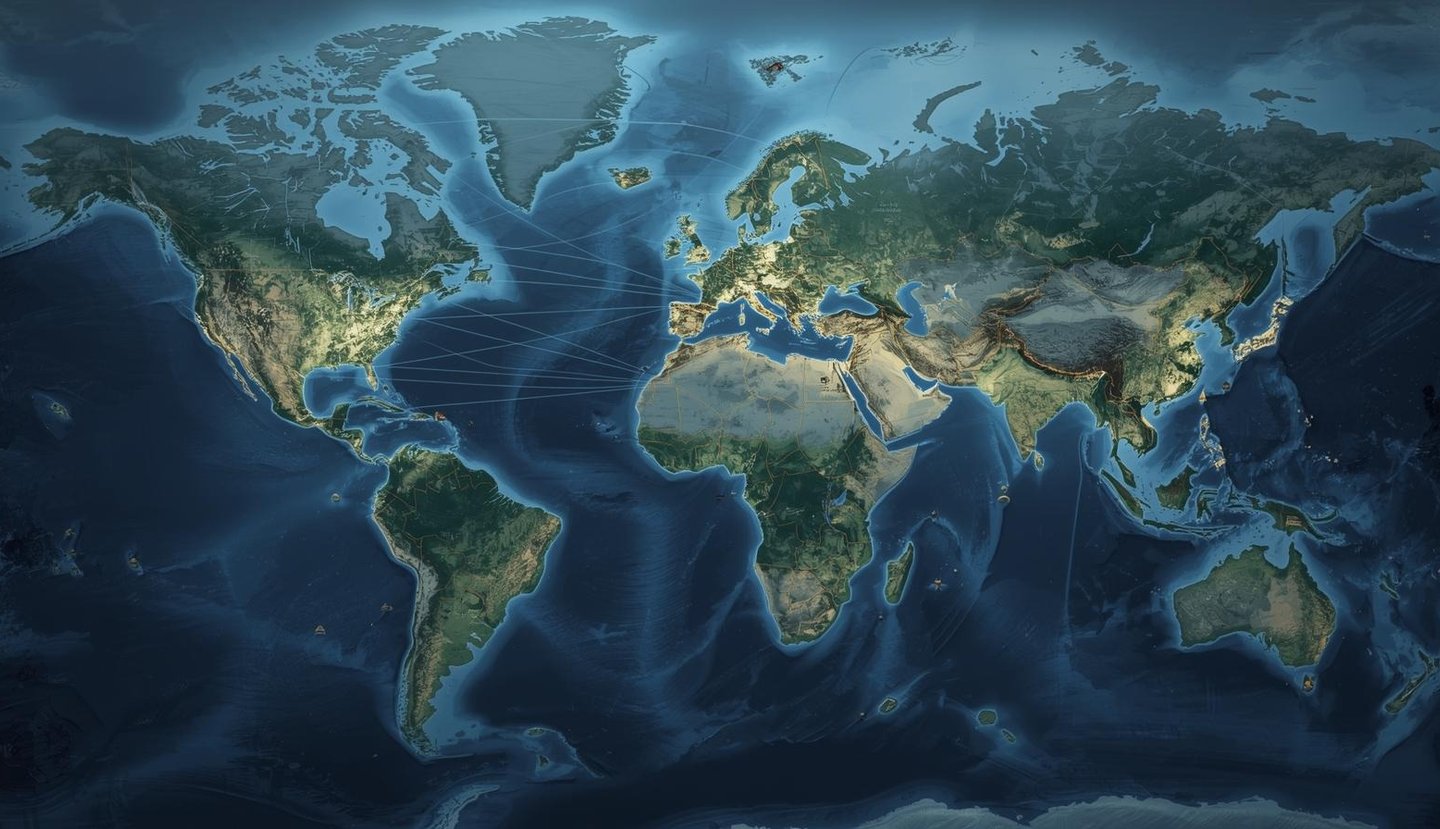
But if you redraw the map based on how the global system actually functions, something strange appears.
The real map of power is not continental.
It is archipelagic.
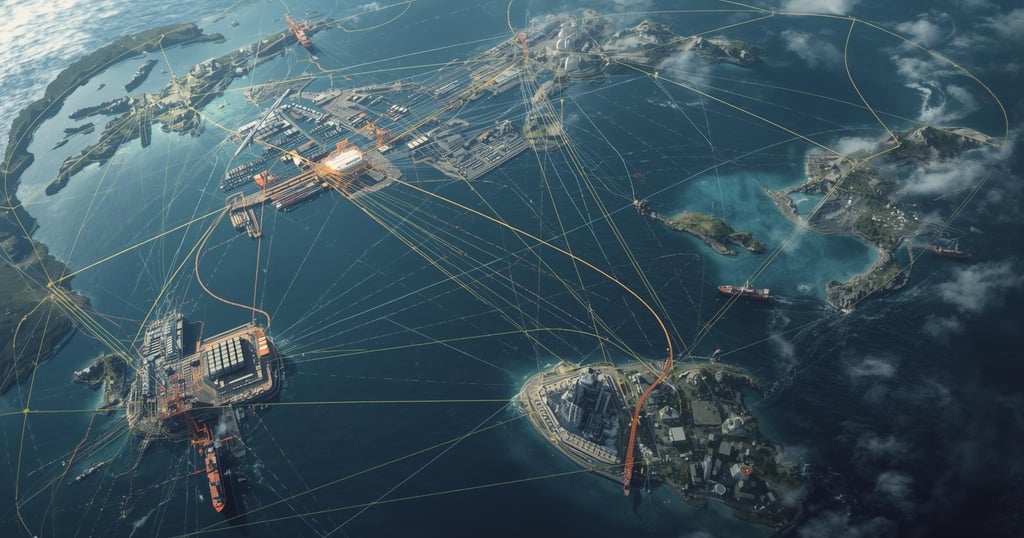
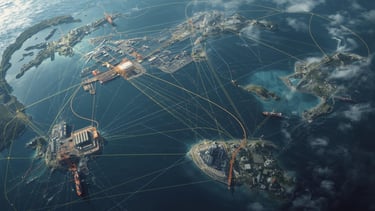
Across the oceans lies a thin necklace of islands that quietly regulate the movement of the planet:
islands near the Strait of Hormuz regulating oil exports
islands around the Strait of Malacca overseeing Asia’s busiest trade corridor
islands in the Western Pacific that anchor military reach across the ocean
islands in the Indian Ocean that watch over the sea lanes linking the Middle East to Asia
islands in the Atlantic monitoring submarine and shipping routes
Most of them are tiny.
Many are smaller than cities.
Yet together they control the circulation system of the global economy.
The World’s Arteries
To understand why islands matter so much, consider a simple fact:
About 90 percent of global trade moves by sea.
But those sea routes do not spread evenly across the oceans. They compress into narrow corridors where geography forces ships into predictable paths.
These corridors—Hormuz, Malacca, Bab-el-Mandeb, Suez—are the arteries of globalization.
Near almost every artery lies a small island that functions like a pressure valve.
From these islands, states can monitor traffic, deploy aircraft, host radar systems, or anchor energy infrastructure. In military terms they are often described as unsinkable aircraft carriers.
But economically they are something even more important.
They are switches in the global system.
The Real Lesson of Modern Crises
Recent tensions in the Persian Gulf have reminded the world how sensitive these switches are.
When maritime traffic slows in the Strait of Hormuz, the consequences ripple instantly through the global economy. Energy markets react within minutes because a significant share of the world’s oil moves through that narrow passage.
But the deeper lesson is not about the strait itself.
It is about the islands and facilities around it that make the flow of energy possible in the first place.
These places reveal a structural truth: globalization has concentrated enormous economic power into extremely small geographic spaces.
Which means conflicts do not need to be large to have global consequences.
A disruption at the right node can shake the entire system.
The Age of Node Warfare
Traditional wars targeted territory.
Modern conflicts increasingly target systems.
Energy networks, shipping logistics, digital cables, and satellite infrastructure have become the real foundations of national power. And those systems often converge at islands.
In effect, the twenty-first century battlefield is not a front line.
It is a map of nodes.
Strike the node, and you do not need to occupy the territory.
You only need to interrupt the flow.
This logic is already shaping military thinking. Strategic planners increasingly focus on controlling or protecting key geographic points rather than conquering vast areas.
The result is a quiet transformation of geopolitics.
Power is becoming topological rather than territorial.
What matters is not how much land a country owns but which nodes it controls in the global network.
Who We Are:
The Economic Nations champions global unity through economic collaboration, focusing on sustainable growth, reducing inequalities, and enhancing global relationships for mutual prosperity and peace.
______________________________________
The Strategic Island Trap
But this transformation has created a dangerous imbalance.
The economic systems that depend on these nodes are global. The security arrangements protecting them are national.
That means the stability of global trade can hinge on decisions made by a single government controlling a small island near a chokepoint.
In an interconnected world, this is a structural vulnerability.
Globalization has created shared arteries without shared guardianship.
A New Idea: Islands as Global Infrastructure
If strategic islands regulate the movement of the world economy, then perhaps they should be treated not merely as territory but as critical infrastructure for the international system.
Air traffic control is governed globally because the skies connect nations.
Undersea communication cables are protected through international agreements because they carry global data.
Shipping lanes already rely on multinational coordination to prevent piracy.
Strategic islands could evolve toward a similar model.
Not by removing sovereignty, but by recognizing that some islands play roles that extend far beyond the interests of the states that own them.
They are not simply pieces of land.
They are junction points in the operating system of globalization.
Turning the World’s Weak Points into Its Strongest Safeguards
If the world continues to treat these islands purely as instruments of national power, they will remain potential flashpoints.
But if states begin to treat them as shared stabilizing nodes—places where maritime monitoring, trade security, and infrastructure protection are coordinated internationally—they could become something else entirely.
Instead of being the places where wars start, they could become the places that prevent wars from spreading.
The Smallest Geography with the Biggest Consequences
History has always been shaped by geography. Mountain ranges, rivers, and oceans have defined civilizations for centuries.
But globalization has created a new kind of geography.
One measured not in continents, but in nodes.
And many of those nodes are islands so small they barely appear on maps.
Yet they control the movement of oil, goods, data, and military power across the planet.
In the coming decades, the stability of the global system may depend less on the size of nations than on how wisely the world manages these tiny pieces of land scattered across the oceans.
Because sometimes the most important places on Earth are the ones that look insignificant.
Contacts
enquiry@economicnations.org
(xx) 98-11-937-xxx (On verification)